

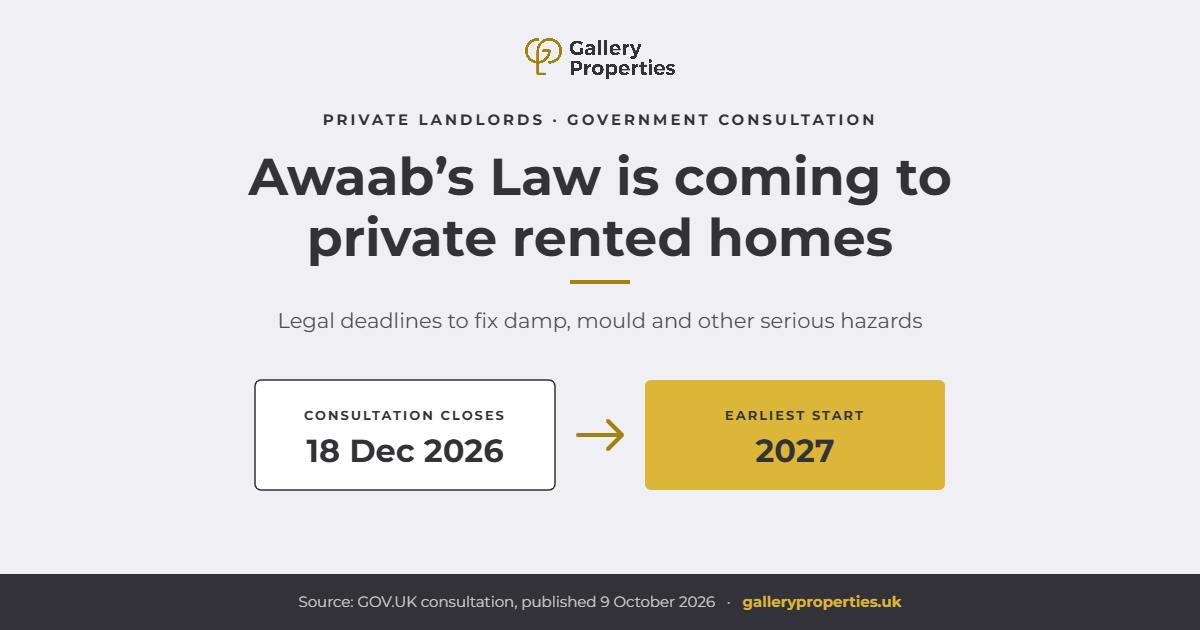
Private landlords in England are set to face legal deadlines for dealing with damp, mould and other serious hazards. On 9 October 2026 the government opened a consultation on how Awaab’s Law should apply to privately rented homes. It closes at 11.59pm on 18 December 2026.
In short
- What: fixed timescales for investigating and making safe serious hazards in rented homes.
- When: not decided. 2027 at the earliest, and the government is asking whether to wait for the new landlord ombudsman, expected in 2028.
- Which hazards: the proposal is every hazard in the official housing safety rating system except overcrowding. That includes damp and mould, excess cold, electrical safety, fire and falls.
- Enforcement: written into every tenancy, so a tenant could take their landlord to court for missing a deadline.
- Have your say: until 18 December 2026.
What is Awaab’s Law?
It’s named after Awaab Ishak, who died in 2020 aged two from a respiratory condition caused by prolonged exposure to mould in his family’s social rented home. His parents had complained repeatedly. Since October 2025, social landlords in England have had to investigate and fix serious hazards within fixed timescales.
The Renters’ Rights Act 2025 gave the government the power to extend this to private tenancies. The consultation is about the detail: which hazards, how fast, and from when.
Awaab’s Law doesn’t add new repair duties. Landlords already have to keep homes in repair and fit to live in. What it adds is a clock: clear deadlines, and a record of when you knew about a problem and what you did.
The starting point: the social housing rules
The government is using the social housing rules as its starting point, and asking whether private landlords should follow the same timescales or different ones.
| Step | Social housing rule today |
|---|---|
| Investigate a possible serious hazard | Within 10 working days of becoming aware of it |
| Send the tenant a written summary of the findings | Within 3 working days of the investigation |
| Make the home safe (temporary fixes allowed) | Within 5 working days of the investigation |
| Start further work to stop it coming back | Within 5 working days, or book it and start within 12 weeks |
| Emergency hazards | Investigate and make safe within 24 hours |
| If the home can’t be made safe in time | Landlord arranges and pays for alternative accommodation |
The consultation is open about the differences. Most private landlords have one or two properties and book tradespeople one job at a time, rather than having a repairs team on call. It also has doubts about requiring alternative accommodation, which for a landlord with a single property could mean paying for a hotel.
Already in force: fines of up to £7,000
One change has already happened. Since June 2026, councils can fine landlords up to £7,000 for failing to take reasonably practicable steps to keep a rented home free of the most serious (“category 1”) hazards. That’s on top of improvement notices and other enforcement.
Landlords of flats: a question to watch
Around 40% of privately rented homes in England are leasehold. If damp is coming from a roof or wall that the freeholder is responsible for, the landlord can’t fix it themselves. One option in the consultation is to require the landlord to take reasonable steps to get the freeholder to act, such as reporting the problem and asking for repairs. If you let a flat, now is a good time to check who is responsible for what under your lease.
Why finding tradespeople matters
The chair of Parliament’s housing committee welcomed the consultation but warned that smaller landlords, especially in rural areas, already struggle to get skilled tradespeople. Across Evesham and the villages, that will sound familiar.
If we manage your property, repairs go through our own in-house maintenance team, Spectro, rather than waiting for a gap in a contractor’s diary. Every repair report is logged with the date it came in and what was done, which is exactly the record Awaab’s Law will expect.
What to do now
- Act on damp and mould reports quickly, and keep a record: when you heard, what you checked, what you did and when.
- Make it easy for tenants to report repairs, and tell them how. Our tenants can use our online repair reporting.
- Check ventilation, extractor fans and heating before winter. Condensation is the most common cause of damp, and good ventilation and heating go a long way to preventing it.
- If you let a flat, know which repairs are yours and which are the freeholder’s.
- Respond to the consultation by 18 December if you want your view counted. Read it on GOV.UK.
Worried about damp or mould in a rental?
Book a free compliance check. We’ll look at your property’s condition and paperwork and tell you what to sort before winter. Not with us yet? Our Premium, Gold and Economy packages start with a free 60-day trial.
Book a free compliance checkCall 01386 443 597WhatsApp 07518 434 214See our landlord fees
Written by Lukasz Rusiecki, Managing Director of Gallery Properties. We’ve managed landlords’ homes across Evesham, Worcester and Worcestershire since 2010.
Last checked: 19 October 2026. This article is general information, not legal advice. The rules for private landlords haven’t been set yet and may change after the consultation. Source: GOV.UK consultation, Extending Awaab’s Law to private rented tenancies.